The glorified calculator
Kenya's mandatory tax register has the computing power of a calculator and the price of a MacBook Pro. That isn't an accident.
An Electronic Tax Register, or ETR, is a device businesses use to record sales and report them to the taxman in real time. That’s ChatGPT’s definition. Mine is shorter: it’s a glorified calculator. It has roughly the computing power of one, and it costs 140,000 shillings, about what you’d pay for a MacBook Pro.
I’ve spent the last few weeks setting one up for a colleague, and it has been a miserable, baffling experience. In a country pushing hard to collect tax more efficiently, why is the one device you need to do it so expensive, so secretive, and sold by only fourteen companies nationwide? And why is every one of them foreign-owned? Can’t we collect our own taxes?
Paying tax shouldn’t cost half your business
Picture opening a small minimart. Three aisles, one till, two attendants. Call it 400,000 shillings to get started while you build credit with wholesalers and distributors.
Now you go to do the responsible thing and register to pay tax. You’re pointed to a vendor who sells you the device for 120,000 plus VAT, so about 140,000. Then they charge you up to 60,000 more to install and set it up. That’s 200,000 shillings, roughly half the cost of starting the business, just for the privilege of paying tax. Trust me, if you saw the device, you would not value it at half a shop.
What surprised me about the price
- KRA doesn’t sell you the device. They refer you to private vendors.
- KRA doesn’t control the price. Vendors charge whatever they like.
- Only fourteen vendors are accredited to provide the service across the entire country.
- Most charge upwards of 140,000, plus whatever they decide installation is worth.
- The same device sells for different prices. Type B and Type C are often the same hardware with a different sticker and a bigger number.
- A thermal printer costs about 7,000. So what turns a 7,000 printer into a 200,000 one? It signs the receipt, prints it, and sends the data to KRA. What else is in there? A magic, golden, all-seeing hamster?
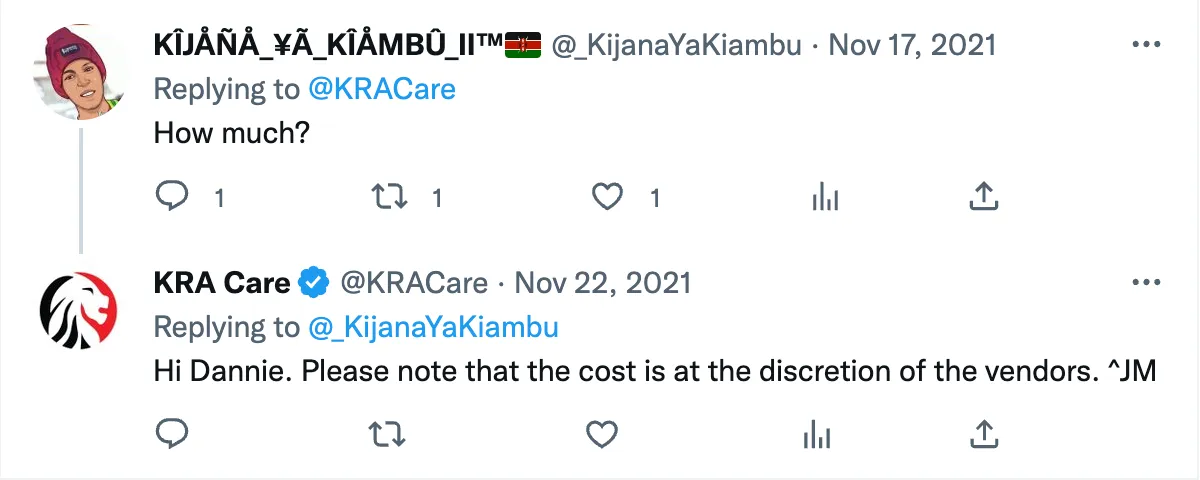
I didn’t invent that second point. Ask someone how much, and KRA’s own support account tells you the price is whatever the vendor decides.
A thermal printer costs seven thousand. The gap between there and two hundred thousand isn’t technology. It’s a markup nobody is allowed to question.
Why only fourteen?
Fourteen vendors, for a device every formal business in the country is required to own. If the goal is genuinely to get everyone paying tax, that number is absurdly small. KRA already runs an API. Why not put it on eCitizen, let me send the data and get my receipt signed there, and skip the middlemen entirely?
Or maybe the small question answers the big one. Maybe someone benefits from a public service being funneled through a handful of monopolies.
What we could actually do
- Widen the pool. It makes no sense to leave tax devices to fourteen vendors while the government employs thousands to check whether you’re compliant.
- Regulate the price. 140,000 is indefensible for what the device actually is.
- Guarantee availability and compatibility. The devices should be easy to get and should work with the range of POS systems businesses already run.
These systems could genuinely make tax collection more transparent and efficient. But not while they cost this much, vary this wildly, and come from so few hands. Widen the pool, cap the price, fix the compatibility, and you might actually get every business on board, which was supposedly the point.
This sat in my drafts for nine months before I first published it. I don’t think much has changed since.